Steel Pans Influence (Steel Drums Influence)
on Other Instruments
E-Pans™
E-pans™ or electronic steel pans, provide another method of delivering a ‘steelpan sound’.
They were created by Trinidadian Salmon Cupid and are essentially electronic synthesizers in the shape of a steel pan.
The standard note placements of the tenor, double seconds and six bass pans have been reproduced on the e-pan™ therefore anyone accustomed to playing these pans can play the corresponding e-pan™ effortlessly.
Features
- They are lightweight
- They don't need tuning
- They don’t rust
- They deliver consistent sound and tonal quality
- They have a MIDI port which can interface with other digital instruments or sound modules
They contain a built in library of musical instrument sounds which can replace the steelpan sound if needed and also provide play-along accompaniments
The e-pan requires an external power source
Source: “The E-pan: A Short History.” New Advanced Product Evolution Home Page. Online. 14 June 2008.
http://www.napeinc.com/product.htm.
P.H.I. (Percussive Harmonic Instrument)
P.H.I. (pronounced fie) is the latest technological innovation from the Steelpan Research Laboratory at the University of the West Indies, St. Augustine Campus (Trinidad).
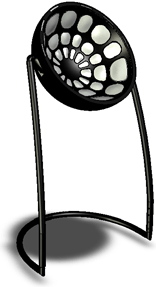
Picture courtesy of Panadigm.com
It is a MIDI-based electronic instrument that merges MIDI with a form inspired by the traditional steel pan. The P.H.I.'s capabilities can be compared to the electronic keyboard.
The interface design provides a 36-note layout in 12-note concentric circles similar to that of a 4ths and 5ths tenor pan. This provides an immediately familiar interface to most pannists.
Features
- They are portable, lightweight and durable
- The MIDI technology in the P.H.I allows greater flexibility in creating, editing and arranging music
- The P.H.I. can be played using sticks or fingers
- It has the ability to score the music being played
- It contains a built in library of musical instrument sounds which can replace the steel pan sound if needed
The P.H.I. requires an external power source.
Source: “Welcome to The World of P.H.I.” Steelpan Research Laboratory, The University of the West Indies, Trinidad and Tobago
Website: http://www.panadigm.com.
Hang (Hang Drum)
The Hang (pronounced hong or hung, plural hanghang) may not look like a pan but steel pans influence on this instrument is evident when it is played. The Hang was developed in Switzerland in 2000 by Felix Rohner and Sabina Schärer after years of research into steel pan and other instruments such as gamelan, gongs and bells.
It is made of two metallic hemispheres joined together. Each hang contains 7-9 notes. The instrument is played by hand and produces a softer warmer tone than steel pans. Depending on how it is played, it can also sound like a harp or bells.
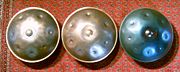
Picture courtesy of Wikipedia: The Free Encyclopedia
Source: “Hang (Musical Instrument).” Wikipedia: The Free Encyclopedia. Online. Internet. 14 June 2008. http://en.wikipedia.org/wiki/Hang_(musical_instrument).